Friday, May 1, 2020

Man Becomes First Ever to Snowboard All 90 Couloirs in the Legendary ‘Chuting Gallery’ Guidebook for Northern Utah’s Steepest Lines

'Snapdragon' — #32.
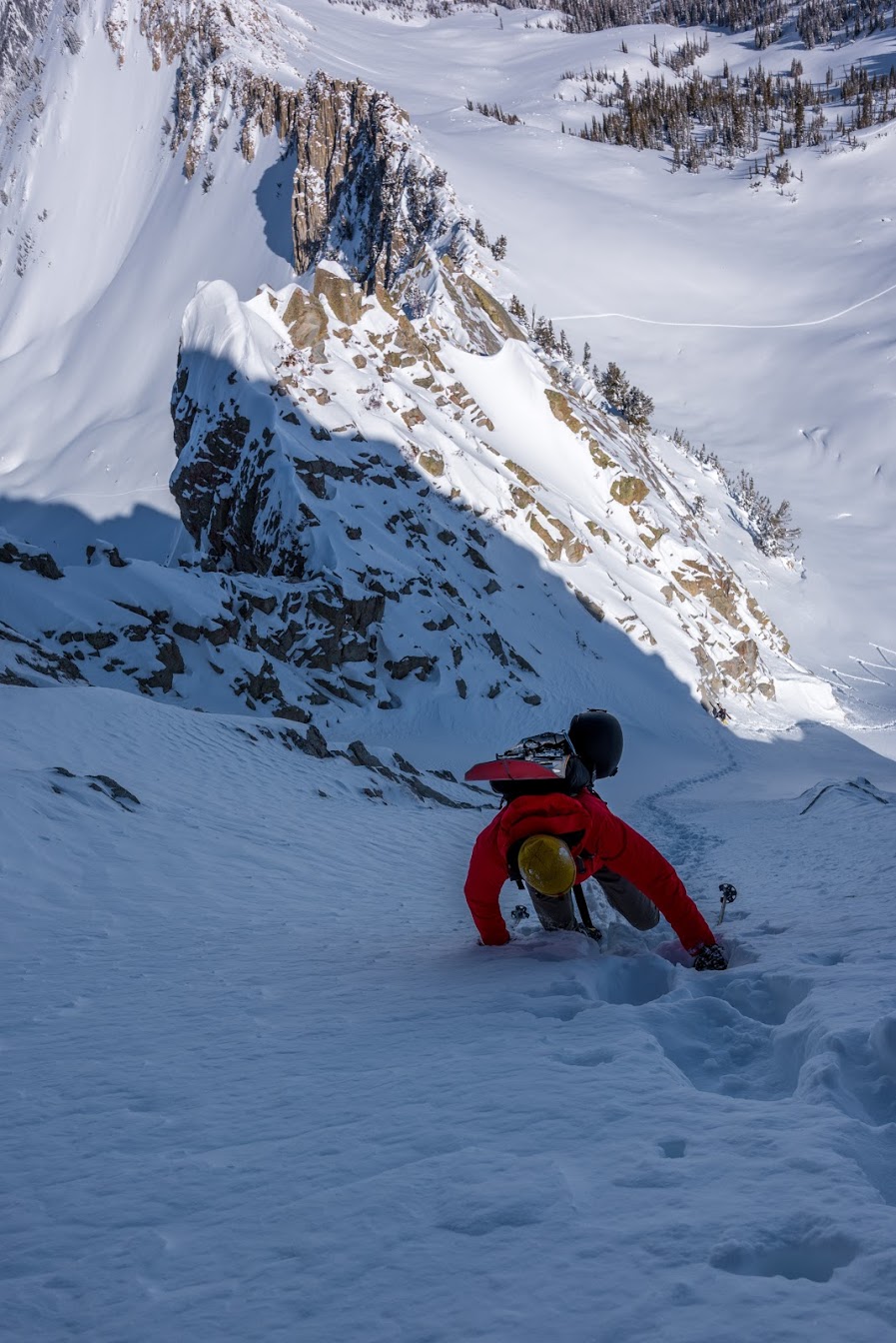
On April 28, 2020, Mike Meru became the first person ever to snowboard all 90 Northern Utah couloirs in the famous Chuting Gallery guidebook when he successfully completed the final descent of his project on the NE Couloir of the Pfeifferhorn.

The two-year-long mission took him through ups and downs and valleys and mountains — quite literally.

But his story as to why he began this project is much deeper and meaningful than you might think. It's not all just about powder turns and shredding sick lines.

'Grunge' Couloir.
SnowBrains reached out to Mike via email to ask him some questions about his recent triumph and he was more than happy to chat about his journey of determination and growth with us. Here's what we asked him and what Mike had to say:

SnowBrains: Can you give a little bit of a backstory as to what got you interested in this project?

Mike: As I've sat and reflected about finishing the gallery and all of the experiences over the past 13 seasons in the Wasatch, the biggest takeaway is that there is no way I could have done this alone. My main ski partners Michael Aasheim (most talented big mountain photographer in UT), Justin Morgan, Eduoard Saget, and so many others have been there each step of the way. We rely on each other and I literally trust my life with them. There are countless other great individuals I ride with and am grateful for, but two others are would be remiss if I didn't mention. A great friend and absolute all sport slayer Taylor Palmer who led the Ribbon, and Don Hatch who was a huge support and inspiration for me right after I broke my back.

In the end, there are so many absolutely inspiring splitboarders in the Wasatch who rip harder than I do. I just feel honored to be listed amongst the names of the guys and gals who get after it here.

Mike on the 'Ribbon.' Photo taken by Taylor Palmer.
Can you tell us a little bit about yourself, where you’re from, and how long you been skiing the Wasatch?

My name's Michael Meru. I'm from Thousand Oaks, CA and I've had two stints in the Wasatch totaling 13 years. Most recently, I've been here full time since 2012.


'HOD' — #15
What initially inspired you to embark upon this quest?

I first moved to the Wasatch right after high school in 1999 to shred pow, build jumps, and hike in the backcountry.  I remember hearing about this couloir book that had just come out. I took a look but didn't give it much thought at the time as my focus was elsewhere. Fast forward 8 years and my passions had turned to splitboarding, so I grabbed a copy, stuck it in the bathroom, and would peruse the lines every so often. I wasn't focused on getting them all at the time, but I looked to it for inspiration and new ideas of lines to ride. Fast forward another decade or so to the beginning of last winter and a few of us were talking about how many of the lines we had already ridden. I hadn't counted them until that day and when I did I realized I was already about halfway there. It was then I decided I wanted to finish and from there it was on.

A bit more backstory. In March of 2013, I broke my back freeriding. I jumped off a cliff, landed on my feet but hit something hard underneath, blacked out, and when I woke up I was paralyzed from the waist down. For an hour and 15 minutes, I had zero feeling in my legs as I lay in the snow with my friends holding my head. I thought my life was over, but after about that 1:15, I started to be able to feel my toes again. We got to the hospital and I had to have emergency surgery to place a cage in my back and fuse T11-L3 together. My neurosurgeon told me I may never walk properly again, let alone snowboard. It was during the lengthy recovery that I told myself I would never let this end my life and I pushed hard to accomplish a lot of things many thought I couldn't. Snowboard off the summit of Denali, do huge days in the backcountry, and shred lines that pushed my limits, not ones chosen by them. So a couple of years ago when I looked at the book again and how many I had left, I wanted to prove to myself that I could still do it despite the injury and years of recovery it took.
As for the time it took, the short answer is It took about 18 years of not thinking about it, and another two seasons of focus to finish.

'White Pine Couloir' — #29.
"We got to the hospital and I had to have emergency surgery to place a cage in my back and fuse T11-L3 together. My neurosurgeon told me I may never walk properly again, let alone snowboard. It was during the lengthy recovery that I told myself I would never let this end my life and I pushed hard to accomplish a lot of things many thought I couldn't."
What were some high and low moments during this project?

Oh man, I'd say that most of the lines were high moments. The Wasatch and specifically the Central Wasatch is this tiny little compact range with so many absolutely incredible lines in it that I honestly enjoyed most of them. I think the main challenge for me was trying to get back into shape both physically and mentally after breaking my back. Another moment that was pretty wild was when Taylor Palmer was leading the Ribbon on Devils Castle with Justin Morgan and I behind. Taylor was at the crux where literally half of your board is hanging off an 800' cliff when a 4'x3' chunk of the wall came off and hit him. His board creased, his binding high back snapped, and he came unstrapped. Such a scary moment. He held his composure, strapped back in, and took a selfie haha. That's Tay. All while Jamo and I were about to drop a load in our pants haha. 

'Montgomery's' — #14
"Taylor was at the crux where literally half of your board is hanging off an 800' cliff when a 4'x3' chunk of the wall came off and hit him. His board creased, his binding high back snapped, and he came unstrapped. Such a scary moment. He held his composure, strapped back in, and took a selfie haha. That's Tay. All while Jamo and I were about to drop a load in our pants haha."
How does it feel to accomplish something of this magnitude?

This one meant a lot to me personally, simply because I was able to prove to myself that I could still shred and ride big lines after the broken back. And whether it was me, or one of the slew of other absolute crushers splitboarding in Wasatch, I think it's great to show that snowboarders are also pushing the limits of big mountain riding, and that despite having only one edge, we can get into technical and consequential terrain safely as well. 

Salt Lake Twins with Mike Meru and Tanner. 'Crow' — #8

What's next?


Well in the immediate future: get out and start canyoneering in the desert with the three ladies in my life (my wife Melissa and daughters Elle & Emme). But as far as snowboarding goes, the overarching goal of finding solace in remote and beautiful places remains. My drive in snowboarding is visiting remote ranges in search of striking couloirs. My main ski partners, Mike Aasheim, Justin Morgan, and Eduoard Sage have a very similar mindset, so I'd love to get out with them next season in search of big lines! 


'Snapdragon' #29.
Oh man, that's a tough one! I'd have to say the best line in the Gallery in my eyes is the Grunge Couloir on Timp. It's one I go back to at least once a year. When you get it in pow it's hard to beat! A few others that are high on the list for me are Montgomery, Lone Peak's NE Couloir, and Lisa Falls. And for the worst... I know I'm going to offend someone with this, but I'd have to say for me it's the Hallway. It's just my personal opinion, but I don't love it. Still better than a ski resort though haha.

Mike walking towards 'The Grunge' couloir on Mt. Timpanogos.

Do you have any advice you’d give for people who want to do what you did and ski all the lines in the Chuting Gallery?


Get the education, find partners you trust, be patient, and make it happen! 

PHOTOS

Pfiefferhorn with Mike and Kirsten — #4
'Little Pine' — #8.
'Tuscarora' — #10

Thursday, April 23, 2020

Utah’s ski community roars on in a now quiet world

Alta Ski Area had to shut down mountain operations over a month sooner than planned due to the COVID-19 pandemic. Photo by Alta Ski Area

When ski area employees across North America went to bed one night in mid-March, they still had a job. By the morning, thousands were out of one.
 

COVID-19 hit the world economy hard, but it hit the ski industry especially hard. The ski community in Utah was not exempt. Some seasonal Little and Big Cottonwood Canyon workers were given severance pay when they got laid-off or furloughed, while others weren’t. But almost all were told to go home, or at least, elsewhere, as ski areas were shutting down and no longer had means or a reason to house them. But Alta Ski Area, doing what it had to do by closing down a month earlier than anticipated, made their employees their primary concern.  

Alta marketing director Brandon Ott said over the phone that shutting Alta down on Saturday, March 14 was “absolutely the right thing to do,” and coronavirus concerns had been on the skier-only mountain’s radar since March 1. He said that it may have seemed dramatic at the time to close down so suddenly, but then clarified that it wasn’t. 

“You’d think ski areas are safe, with skiers wearing face masks and goggles but that’s not the case,” Ott said. “Really, you’re sharing chair and gondola rides, waiting in lines, and touching things.” 

Alta Ski Area typically operates for 151 days during the winter season but, due to an invisible foe, lost 25 percent of their season. But while many ski area employees around the world were kicked to the curb when their employers starting shutting things down, Alta approached the situation a little differently.

The ski area offered seasonal workers a few extra weeks of pay even though they were not working. And — to Alta’s luck — they didn’t have to lay-off or furlough any single one of their full-time staff, according to Ott. Instead, they kept them onboard by adapting their work routines to new precautions aimed at preventing the spread of COVID-19. 

According to Ott, they’re “taking care of the Alta family” by limiting the number of people working in offices, spreading out schedules, and vigorously disinfecting surfaces. Because of the way the ski area is managed and operated, Alta was in a good position to handle this sudden pandemic. 

“It pays to be a little smaller — to be a ski area and not a resort,” Ott said.

Because Alta doesn’t have a large-scale summer operations program, and because it doesn’t actually own any of the lodges around the mountain, they were in a manageable position to shut down a month early. Many other ski areas rely on the profits driven from their summer operations, which at this time are uncertain as to whether they will still happen. In the meantime, while snow continues to fall from the sky, Alta is allowing the public to earn their turns at their ski area. 

Uphill travel is allowed at Alta at this time, and snow-cats are grooming a select few trails every morning. According to Ott, this is a major key to prevent bottlenecks at popular backcountry trailheads in Little Cottonwood Canyon — by letting the public rip the wide-open ski area. Employees are also cleaning ski area bathrooms daily and Utah Department of Transportation crews are still plowing the roads when they need plowing. 

It should also be noted that Alta has seen a solid amount of snowfall this season, despite closing early, with 540 inches of snowfall at the time of this writing. To put that into perspective, Alta’s 40-year season average is 548 inches. 

Yet, no one really knows what all is going to come of this pandemic, and what next season is going to look like in the Little Cottonwood Canyon. What will pass sales be like for the 2020/21 ski season? When asked about the uncertain future, Ott said:

“Really, we’re taking care of our employees first. We’re in no rush to talk about pass pricing just yet.”

A time-lapse photo of the town of Alta tucked away at the end of Little Cottonwood Canyon. Photo by Alta Ski Area. 

With that in mind, Alta is doing what it can for the many skiers that call this mountain home. Across the Wasatch traveling north, Powder Mountain, too, is doing what they can for their family of full-time and seasonal employees. 

Powder Mountain had an original closing date of April 12, 2020, but like Alta, the virus shut them down a month early. The ski resort responded initially by adapting operational measures while keeping their mountain open. They closed down lodges, spaced out lift-lines, and discontinued ski school. But, by remaining open with strictly enforced social-distancing measures, they ran into a new problem that they’ve never faced before: More people than ever were coming to ski Pow Mow because it was the only ski resort open for hundreds of miles in every direction. 

“We had a really good plan,” Powder Mountain’s marketing manager JP Goulet said. “But the issue with all the other ski resorts closing was that people were now coming from all over the U.S. and Canada to come ski Powder Mountain because we were one of the last bigger ski resorts open. Which is the last thing you want, you know, people traveling to other places in a time like this.” 

The final nail in the coffin for Powder Mountain’s season abruptly came when Utah Gov. Gary Herbert proceeded to issue the stay safe, stay home directive on March 27. That’s when Powder Mountain made the swift decision to cut their losses and shut resort operations down. 

Conveniently enough, most of the resort’s J-1 employees had already left the week prior and Powder Mountain was actually looking to hire new employees before ultimately deciding to shut down, according to Goulet. So, although some of Powder Mountain’s employees were laid-off, the resort didn’t have to let go near as many employees had they been forced to shut down a week or two sooner. Like Alta, too, Powder Mountain doesn’t have an extensive summer operations program. They have cross-country bike trails, which are open to the public, and should remain open this summer, according to Goulet. 

With the mountain closed, resort employees have a lot of time to think. Everything is still up in the air about how the ski industry is going to be affected long-term by the coronavirus, and a lot of uncertainty lingers. But Goulet is confident about next season. 

“We’re in a really good position to open [next season] because we never put that many people together anyway,” Goulet said. “We average three acres per skier.” 

Three acres of skiable terrain is more than enough for one skier, providing adequate space for social-distancing. The best Powder Mountain can do at this time is remain hopeful and play on their strengths, like their limited pass sales and very-spacious ski resort that boasts the most skiable acreage in the United States. But ski areas aren’t the only ones playing their part to help the ski community at large in the midst of a global pandemic. Several Salt Lake City non-profit organizations have taken matters into their own hands. 

A snow-cat at Powder Mountain. Photo by Powder Mountain.

Becca Fenander has been with the Alta ski patrol for 26 ski seasons and is the current president of Amazing Ski and Snow People, a non-profit organization that’s mission is to “support the physical, social, and mental health, education, and infrastructure needs of the ski patrol community.” Her organization helps the Little Cottonwood Canyon ski community with an emphasis on Alta ski patrollers.

When the going got tough with the pandemic and canyon employees were suddenly out of a job, Fenander and her organization stepped up to the plate. They started what’s called the “Little Cottonwood Canyon Coronavirus Relief Fund,” which is a fundraiser designated towards enhancing the wellbeing of the community by swiftly responding to the emergent needs of canyon employees who have lost wages and housing because of the mandatory shut-downs.

Fenander said that the easiest way to help the LCC community is simply by donating to the fund. “Anything helps,” she said. The relief fund has a proposed goal of $20,000, and, so far, Fenander is only $3,450 away from hitting that goal. To donate, click HERE.

“It’s about more than just money,” Fenander said. “It’s about an upwards spiral of wellbeing.” 

Fenander said that any surplus donations will be split 50-50 with Alta Community Enrichment (ACE) and Get Us PPE which are other non-profits. 

Amazing Ski and Snow People is adapting their organization as best they can, like everyone else during these strange times. ACE is too, and they’ve seen much recent success with the way they’ve been handling the situation. 

“We intend to create a community even when we can’t be near each other,” Sara Gibbs said, the executive director of ACE. 

Alta Community Enrichment is a non-profit organization that has the vision of creating a strong community by bringing people who live, work, and play in Little Cottonwood Canyon together to share the arts, culture, and education. According to Gibbs, ACE has four clear goals that help the community take interest and become involved. They are:
  1.          Supporting local arts and artists.
  2.          Bringing opportunities in the arts, culture, and education to the community.
  3.          Increasing awareness of the variety of activities that take place in our community. 
  4.      Having a strong, high-functioning Board of Trustees. 
Gibbs said that ACE was actually the very first entity in Alta to shut down because of the coronavirus before the rest of the town followed suit. As she put it over the phone, the early shutdown of canyon ski areas was “absolutely crushing,” not only to her but to everyone affected. That includes ski area employees, lodge workers, cooks, bartenders, maintenance crews — the list goes on.

“The average worker in Alta makes about $150 a week. That’s barely enough to live,” Gibbs said.

That’s why ACE gives back as much as they can to the community because without that community, the non-profit wouldn’t survive, according to Gibbs. Like Fenander with Amazing Ski and Snow People, Gibbs also had to step up to the plate and make drastic changes to the way ACE does things when the entire world changed overnight. 

ACE had 34 events planned before Alta Ski Area hurriedly closed. They were all painfully canceled. Yet, instead of giving in to change, ACE embraced it. They’ve moved many of their scheduled events to virtual outings online via social media platforms like Instagram.

For example, the Alta Gala is a staple for end-of-the-ski-season events and is basically one big party of rowdy skiers dressed in costumes, dancing and drinking, with the event's proceeds going towards philanthropic purposes in the Alta community. ACE reoriented it as a virtual event this year. Instead of meeting up at the event, party-goers logged into their Zoom accounts and partied on from home. And that’s not the only instance where ACE has shown resilience in the face of adversity. 

Gibbs said that ACE has already created 16 virtual events since the pandemic began, and plans to create more. Of these virtual activities are a downloadable coloring book, free for all, and ACE-sponsored yoga sessions taking place via Instagram Live every day with Alta yoga instructor, Marie “Sunshine” Heywood. 

“ACE doesn’t pause for the community,” Gibbs said. 

So, even when the global economy pauses, when the ski industry comes to a standstill, and when the world seemingly stops spinning for a moment, there remain those who continue to push back against the creeping tides of change. And luckily for us, those people are skiers. 

Tuesday, April 14, 2020

Hope for the Ski Industry: 3 Nations Still Have Open Ski Resorts — More May Open Theirs Soon

After two months of tight lockdowns, China reopens two of its indoor ski areas. Photo by inthesnow.com
As the world stands still, ski lifts everywhere have stopped spinning. All North American ski resorts are now closed, there are rumors that ski areas in New Zealand and Australia may not open for their winter season, and a tremendous amount of uncertainty is present about how the next ski season is going to look due to the possibility that further waves COVID-19 infections can still impact the general population. But two nations — Sweden and Japan — are still hanging in there by keeping a select few of their ski areas open. And, according to the FIS, China has recently reopened two of its ski areas but they are currently operating with a restricted number of guests and other anti-virus-spread initiatives.

In the far north of Sweden, there are still two ski resorts that remain open: Björkliden and Riksgränsen

Both of these Swedish ski areas are owned by Lapland Resorts and are located well above the arctic circle. They are known for their beautiful scenery, variety of skiing, and excellent snow conditions. Even though Lapland Resorts is keeping its resorts opening during the COVID-19 pandemic, they have addressed the situation and mentioned the possibility that they may begin limiting pass sales. They wrote in a statement on April 6, 2020:

UPDATE ON 06/04/20 - 16:30

Kara Guests, 
Additional information about Ski Pass 
We get some questions regarding our announcement on April 2; " Sales of external ski passes may be limited to a maximum number." 
Season ticket holders and residents at Lapland Resorts always have access to the ski systems and transfer bus for lifts / bus rolls. Since we cannot know in advance exactly how many people appear on the slopes, we must reserve the right to be able to stop new sales of Skidpass if congestion begins to occur. 
On April 2, we announced that new bookings for Lapland Resorts have been stopped. The number of already booked accommodation guests is currently only about one third compared to "normal" Easter week and there will be no more, but perhaps fewer. The border from Norway is in practice closed. Thus, it seems likely that no great pressure from ski stoves will arise for our ski systems. 
If all guests in our ski system are careful to keep their distance and take into account, our assessment is  that we will not have to stop new ski pass sales.
Information about Lifts 
In Björkliden, Lappbergsliften closes at 15.00 for the rest of the season. The pot lift rolls as usual until April 13, then closed the rest of the season. Other lifts go as usual.
In the national border, the Nordalsliften will be closed for the rest of the season. Katterjåkklift's open holding is expanded and it rolls from 09:00 to 16:00 until now (today, however, 10:00 - 16:00). Other lifts go as usual. 
We look forward to a quiet, safe and respectful Easter weekend. 
Warm Greetings from Lapland Resorts
Northern Sweden has no shortage of snow this season. Riksgränsen ski patrol work to get the lifts running again on Feb. 21. Photo by Riksgränsen/Facebook.
Björkliden has a planned closing date of May 3, 2020, and Riksgränsen expects to close on May 17. 

It should be noted as well that Sweden is handling the COVID-19 crisis a little differently than other nations. And by a little, I mean a lot. Sweden is charting a different course, according to Vice News: "It’s keeping schools and businesses open, with the idea that resistance to a disease comes when enough people in the general population have survived it — aka "herd immunity.”

Meanwhile, in Japan, six ski resorts remain open. They include:

Niseko United in Japan is still open. Photo by Niseko United.
Niseko United addressed the COVID-19 crisis and its decision to remain open in a statement below.
Due to the recent outbreak of the coronavirus (COVID-19) around the world, many people have been asking us, “Is Niseko United still open?”. The answer is yes! Niseko United is still spinning lifts for the public to enjoy our slopes. However, the operation of the resort is subject to change given the snow conditions as well as the development of the coronavirus pandemic. Here are the scheduled closing dates for each resort of Niseko United
Annupuri – May 6th, 2020 
Niseko Village – Closed April 12th, 2020 
Grand Hirafu – May 6th, 2020 
Hanazono – Closed March 29th, 2020 
March gave Niseko several storms of fresh snow, so there is currently enough of a snow base to keep operating. This means fun spring skiing conditions in Niseko! Come up to the slopes early to carve the corduroy while it is cold and fast, or wait for the snow to warm up and enjoy slashing around in the sun and the slush. The famous Hirafu Spring Park will once again be available for advanced park riders who want to enjoy larger freestyle features. 
The entire Niseko community is responding and taking all precautions possible to ensure a safe environment due to the coronavirus outbreak. Ski resort facilities, restaurants, and public spaces have added hand sanitizer dispensers all around for the public to use. Signs and instructions for everyday preventative measures can be found all around to encourage washing hands thoroughly with soap and water, as well as covering your mouth and nose when coughing or sneezing. In Japan, wearing facemasks is a widely accepted way to protect yourself as well as preventing the spread of any disease to others. As facemasks are already commonplace in Niseko’s culture, this adds another level of preventative safety in the area. Niseko is an international community and we understand the importance of working together and preventing the spread of the coronavirus into the area.
Once again, lift operation and closing dates for each resort are subject to change. If you have any direct questions regarding lift operation details for the 2020 spring skiing season, please reach out to each resort individually. Also, please check our live Niseko United lift status page for real-time updates of the chairlifts.
A snowcat grooms the slopes of Niseko in the morning sun. Photo by Niseko United.
In China, Guangzhou and Kunming indoor ski areas are among those that have re-opened after months of being closed due to state-imposed lockdowns. The ski areas are now operating with a restricted number of guests and other anti-virus-spread initiatives. Harbin Snow World 24, the world’s largest indoor ski area, located in the north-eastern province of Heilongjiang, is reported to reopen soon as well, the FIS reports.

Chinese ski areas are beginning to reopen after months of being closed due to COVID-19 related lockdowns.
And then more good news: there's hope for even more ski areas to potentially open soon as well. Ål Skisenter in Norway is hoping to reopen shortly and will be announcing whether or not they will any day now. The ski resort said on their website:
We have, like everyone else, closed due to Korona. But as of April 14, we may be open if we adhere to guidelines from the Institute of Public Health. — Ål Skisenter
In the United States, Beartooth Basin, a summer-only ski area located on the scenic Beartooth Highway that runs between Wyoming and Montana, has announced that they still plan to open on May 30, 2020, for the summer ski season. This, of course, is still subject to change due to the global pandemic that is unfolding by the day, but the ski resort — as well as skiers and snowboarders  — are hopeful that they will still be able to make some turns this year.
Getting buttery at Beartooth Basin in June 2019. Photo by Martin Kuprianowicz.


Tuesday, April 7, 2020

Sun Valley, ID Has one of the Highest COVID-19 Infection Rates in the Nation: Is Skiing to Blame?


Sun Valley Resort in Idaho has one of the highest COVID-19 infection rates in the U.S. Photo by Sun Valley/Facebook.
It appears as though ski resorts in both Europe and North America have served as the initial transmission centers for COVID-19 once the fatal disease escaped China's borders. Ketchum, Idaho — home to world-class ski area Sun Valley — has one of the highest infection rates for COVID-19 in the entire U.S. Another popular ski destination in Austria — Ischgl — has been linked to the spread of over 2,500 cases and is currently the subject of an associated criminal investigation.

But why ski areas? Why skiers? In order to understand how this disease spread as rapidly as it has, you have to take a look at the weeks leading up to this crisis.

In an article written by Michael Ames in The New Yorker, a large gathering of over 700 skiers and snowboarders who traveled from all over the U.S. and parts of Europe is described taking place at Sun Valley Resort in early March. The occasion? They were celebrating the annual Black Summit of the National Brotherhood of Skiers (N.B.S.) which is the largest African-American ski and snowboard association in the world. The event took place on March 6 and featured a performance by DJ Jazzy Jeff, an American record producer, DJ, actor, and comedian who is best known for his friendship and collaboration with Will Smith as DJ Jazzy Jeff & the Fresh Prince.

A packed party scene in the Austrian ski village of Ischgl in March 2020.
Brotherhood members skied, mingled, partied, stayed in hotels, enjoyed large, group dinners, and apparently had blast. But their good times were short-lived. Hundreds of Brotherhood members came down with ghastly symptoms resembling COVID-19 in the week after returning home from their vacation. Many were hospitalized and several have since died. Michael Ames with The New Yorker writes:
By the following week, upward of a hundred and twenty-six members of the Brotherhood had come down with symptoms of the coronavirus. Twenty tested positive for COVID-19, and eight were hospitalized, including three in intensive-care units. On March 30th, DJ Jazzy Jeff announced that he was suffering from pneumonia and associated coronavirus symptoms. In the days since, two longtime N.B.S. members, Nathaniel Jackson, of Pasadena, and Charles Jackson, of Los Angeles, who shared a room while in Sun Valley, have died of the illness.
This was in mid-March. The disease has now spread to all 50 states and can be found in at least 184 countries. And the root of it all could be skiing — or at least skiers, specifically those who travel. You would think that ski gear like gloves and cloth face masks paired with wide-open spaces of fresh mountain air could be potential blockers towards spreading the coronavirus — but that isn't necessarily the case.
“It started as an epidemic of skiers,” German Professor Hans-Georg Krausslich, the head of virology at University Hospital in Heidelberg, said.
Just think about it. When you're skiing at a resort, you're constantly sharing chair lifts and gondola rides with strangers. Who knows how many people they've come in contact with in the past 24 hours alone? You're also touching things like lift-safety bars and lodge door handles, or maybe even wiping your cold, runny nose on your ski mittens from time to time. Those microorganisms live on whatever you touch and can even spread in the air you breathe out, only to be absorbed by the next person that comes within close proximity of you.

In Denmark, the first identified infection came from a Danish skier returning from an Italian ski holiday. In Mexico, the chairman of the Mexican Stock Exchange tested positive after returning from a ski trip to Colorado’s Vail resort, along with several other Mexican nationals who went with him, according to the New Yorker. They are possibly the first individuals who brought the virus to Mexico. Meanwhile, in California, Mammoth Mountain Ski Area has the highest per-capita rate of COVID-19 in the state.

 A photo of a chairlift at Mammoth Mountain, California, which had to close early due to the COVID-19 pandemic. Photo by The New York Times.
Sun Valley, along with all other Vail resorts — and now all North American ski resorts — has closed for the 2019/20 ski season, months ahead of the originally intended closing date. Social distancing protocols are being put in place nationwide and states are being locked down. Densely- populated regions like New York City are seeing shocking numbers of people dying from the coronavirus every day.

Yet, people are still flocking to small mountain or vacation towns. Local authorities — like those in Mono County, home to Mammoth Mountain — are pleading on news and social media outlets to keep people from visiting or staying in their short-term rental properties. This is because the medical system in Mono County and other remote, mountain-areas is already extremely limited and will not be able to handle the stress of the potential tidal wave of COVID-19 cases that is currently crashing down.

So is skiing to blame? Yes, partly. It's to blame as much as any other travel-related activity and industry. It's as much to blame as any organization or individual that was not adequately informed about the dangers of the coronavirus. But we are beyond the blame game now. Now, it is up to us to determine how we will collectively move forward in response to this ongoing, global crisis, with tactics such as social distancing, quarantine, economic shutdown, and the long list of other frightening words that fill up your news feed 24 hours of the day. Yet, a glimmer of hope remains: for hard times make strong people. And even in an absence of doing the things we love for the time being — like skiing a resort — we will only cherish them more once we do finally get to return to them again.


Healthcare workers rush a critical patient with symptoms of COVID-19 to emergency care. Photo by aljazeera.com.